Thursday, 30 December 2010
Você fala Português?
Learning a foreign language from scratch is a feeling I had long forgotten. Most of the languages that I speak (or 'chew', as the Italians would say in a less committal tone!) I learnt as a teenager. The thought of learning a new language at the age of 26 did not seem very realistic until I had a reason and a real need to do so. Needless to say, it is much more pleasant to be learning a new language when you know it is going to have an immediate and practical application, then when you are trying to make sure that your average is not spoilt by that French grammar test that you had forgotten about!
So far learning Portuguese has been a real joy. Not only because it has given me something to focus on - yes, beach life can be hard sometimes!- but also because it has filled my days with plenty of opportunities of interacting with the locals, which is a precious experience when travelling.
Brazilian Portuguese is spoken by almost 190 million people worldwide and although on paper the differences with its European counterpart are only limited to specific vocabulary and a few grammatical rules, in practice the differences are large, spanning grammar, syntax and pronounciation.
Despite not knowing much about European Portuguese, I am under the impression that,for someone who speaks Italian, Brazilan Portuguese may be slightly easier to understand and to get to grips with. The variety of guttural sounds that (to my untrained ear!) sometimes make European Portuguese sound like Arabic, are not there and the musicality of the language makes Brazilian Portuguese much more similar to Italian. To the point that it has actually made me more aware of that musicality in the Italian language that is so endearing to all my British friends and that I have always taken for granted.
But this is not to say that learning portuguese is as easy as drinking a glass of water, as the italian saying goes.While knowing a latin based language is useful in 90% of the cases, there are a few hurdles that are worth bearing in mind. Most of these for me are still work in progress - and will probably remain so until the end of my trip.
Portuguese is more precise than Italian when it comes to expressing a state. If the state is permanent -such as for example when you are talking about where you come from, what you do for a living, what you are like as a person- it uses the verb 'Ser' (to be), but if you are talking about a temporary situation - such as for example where someone is in this precise moment, what mood they are in, where the car is parked etc- it's all about the verb 'Estar' (to stay).
Despite some exceptions like the Roman dialect, Italian is a lot less precise and tends to use the verb to be (Essere) in all cases. And while increasing my awareness of the temporary nature of many things in this world (!) this does mean that I need to think twice when I am talking about things that would otherwise feel very natural.
My solution here so far? Think and speak like a Roman.
Perhaps as essential as being able to talk about how things are is to be able to talk about things that you or other people have. In Italian, the verb 'to have' (avere) is everywhere. Not only is it used to express an idea of ownership but it is also used as a building block to construct many verb tenses. Without it the Italian language - particularly the spoken language- would have serious difficulties working.
'Haver' does exist in Portuguese but it's an impersonal verb that means 'there is/are. 'Ter' on the other hand is what you would be using to talk about the idea of owning/having something. In Italian the verb 'Tenere' literally means 'to keep' and has very little to do with 'to have'... except if you are Sicilian, in which case you are allowed the poetic licence! So here is my next solution- think and talk like a Sicilian.
One of my favourite -yet hardest things to learn- about Brazilian Portuguese is the way in which people agree to a question. Contrary to Italian, where the words 'Si' (yes) and 'No' (no) are all you need to reply, in Portuguese it's rare that 'sim' and 'não' are uses in isolation. Instead people will repeating the main verb of the question in response to a 'yes' or 'no' question. So 'você foi para a praia?' (did you go to the beach?) becomes 'Fui' (I went). Which for Italians who are used to the driest, most monosyllabic answers that could ever exist is very endearing. In Portuguese, when someone answers 'yes' to a question is almost like they had always agreed with you and there would have been no need to ask the question in the first place. And the intonation of the answer adds to this impression by stretching each syllable as much as possible.
As heart warming as this may feel, it also means that one can't get away without knowing verb endings(!)...and this is,of course, where most of the work in progress is!
Pronunciation of most words for someone who speaks a latin based language is ok...until you get to the nasal sounds! The most popular example is the difference between 'pão' (bread), where 'ao' is pronounced with a 'u' sound at the end trough the nose, and 'pau' (stick) where the vowels in 'au' are pronounced as open.
Italian does have a lot of vowel sounds, but all of them tend to be open and pronounced exactly as they are written so it's very easy to forget about this subtlety in portuguese - and when you do everyone knows you are italian, that's guaranteed!
I don't think there is a real solution to this except being patient, keeping your ears open...and perhaps walking up and down the beach speaking out loud the tricky words - yes I have been on many deserted stretches of beach recently!
Like in all languages, spoken and written Portuguese can be quite different. The informal language is as colourful,vivid and expressive, just like the rest of Brazil itself.
Many word endings or beginnings in spoken Portuguese are contracted. The verb 'estar' for example that is so widely used, looses the 'es' at the beginning. Expressions like 'esta bom' (the equivalent of 'ok') becomes 'ta bom' or even 'ta?' when used in a question. The word 'você' becomes ' 'oce' and is almost lost in the midst of all the other words in the sentence, question, remark or exclamation.
As a language, Portuguese is also rich if colourful expressions. There are many ways to ask how someone is and even more to express how well you are...so there are endless possibilities to say that life is great. 'Tudo bom','Tudo bem','Tudo ótimo','Tudo legal','Beleza'...and the list goes on.
Or simply 'tudo' -all (good)- in response to the question 'Tudo bem?' if it's 8 o'clock in the morning and you have just rolled out of bed and are desperately trying to reach for that coffee flask on the breakfast terrace before engaging in any meaningful conversation with any native speaker because stringing a sentence together would be far too demanding at that time of the day.
So far I can definitely say that getting to grips with Portuguese has kept me busy and kept mu mind engaged in many ways that I had long forgotten about. As the brazilians would say, it has reminded me of how much learning languages is 'a minha praia' -literally 'my beach' or as the Brits would say 'my cup of tea'!
I have included a section on Portuguese words on the right hand side corner of the blog which I am going to update daily. Stay tuned for the Portuguese word of the day!
Saturday, 25 December 2010
Praia do Cumbuco- jangadas, kite surfing and Forro
We arrived in Praia do Cumbuco after a 21 hours overnight bus trip from Salvador to Fortaleza, a night in a backpacker's hostel and a 45 minutes ride on a local bus. 'Let's just do one!' said Andrew as we were trying to figure out how on earth we would get from Salvador up to the middle of the coast of Ceara,1236 km north of where we were. 'You can't say you have seen a country until you have done a long bus ride!' said Andrew reminiscing his days of traveling in India. So we 'did one'.Traveling by bus seems to be a popular means of transport in Brazil and the service certainly is tried and tested. There are a variety of companies specialising in various different parts of the country and the connections are pretty good. Our bus went the inland route, taking us through the interior of the northeastern states that lie between Bahia and Ceara, stopping every couple of hours in minuscule agricultural towns of unknown names in service stations that looked pretty much the same as one another. Very pleased that we were catching a glimpse of the side of Brazil that is off the beaten track, I settled in my (almost fully) reclinable seat with a Paulo Coelho book in my hand, occasionally distracted by the scenery, occasionally reaching for another pao de queijo in Andrew's bag. Before I knew it we were arriving at Fortaleza's bus station.
Praia do Cumbuco is a small town 30 km out of Fortaleza, set between several kilometres of white sandy beach fringed by rows of coconut trees on one side and the wilderness of the sand dunes, paradise of buggy riders, on the other. The beach itself has a certain wild feel. Set on a very straight stretch of the coast, it is completely exposed to the strong winds blowing from the Atlantic, which - as we very quickly discovered- make Cumbuco one of the world's capitals of kite surfing.
Like in many other places in Brazil, here the old gracefully blends with the new. The flashy high tech looking kites that frantically whizz around the blue waters are gently counterbalanced by wooden jangadas, the traditional fishing boats of the North East of Brazil laying in endless rows on the sand or floating solitarily in the rough waters. With their distinctive triangular-shaped sails, they make themselves seen from anyone who is at sea or at land almost like flickering flames in the vastness of the horizon.
Cumbuco is equipped to host a substantial amount of tourism and clearly benefits from the trade linked to the kite and wind surf business almost all year round. The international community that has grown around this is impressive with a strong presence of Dutch, Germans and British aficionados who set aside several weeks of the year to come this corner of paradise to practice their favourite sport - and, undoubtedly- to enjoy the chilled, friendly and informal vibes of the local community. The Dutch presence is particularly striking - maybe they have never left since they first invaded this part of the country in the 17th Century?? But our question is answered during one of our breakfast conversations with Jall, a Dutch friend who is staying at the same pousada as us who explains that kitesurfing is big in Holland because of the very favourable winds and the Dutch have therefore taken to this sport like ducks to water - or birds to wind?
But the international feel of Cumbuco is nicely counterbalanced by a strong local community which has embraced the benefits brought about by tourism and yet seems to be remaining strongly rooted in its rhythms and ways. The heart of Cumbuco is the square featuring the local church, a concrete football pitch lined by an almost worn out metallic net and a large white washed building, home of the local fishing trade. Houses and shops run by the locals alternate, to the point where it's difficult to tell what's for private use and what's for business.
Most of the local life takes place outside. In this, Cumbuco reminds a lot of Sala, the small village where I grew up. In the warm summer nights, the little square is literally buzzing with life. The pitch becomes the stage of many late night football games, capoeira rodas and maculele shows...all happening at the same time! Meat skewers are constantly sizzling on the barbecue of a small food stall next to the church - which we dubbed 'the late night burger van' albeit much better when it comes to the taste of the meat and the smiles with which it is served (they come for free!). Locals sit outside on their verandas chatting in an animated way and enjoying their cold beers.
Christmas Eve in town was not to be missed. Making our way back from the Christmas roda of Monitor Wyll who runs the local capoeira group here in Cumbuco under the banner of the larger Grupo Muzenza, we found the town in full swing and ready to embrace the Christmas celebrations. Pizza, Caipirinha and a first go at Forro, a traditional norteastern type of music and dance courtesy of a local live band were a perfect start for our Christmas here in Brazil. And - who knows- kitesurfing might be next...watch this space!
Tuesday, 21 December 2010
A night of Capoeira at Mestre Curio's academy
Wherever you are in Salvador you are likely to encounter capoeira. Whether you decide to venture up to the Forte de Santo Antonio to visit one of the academies of the many grand masters that work here or simply taking an evening stroll on the Terreiro de Jesus in Pelourinho or passing through the Mercado Modelo to get on a boat at the nearby marine terminal, you are almost guaranteed to catch a glimpse of it.
Mestre Curio's academy is based in the Forte de Santo Antonio, otherwise known as the 'Forte da Capoeira', a beautifully kept 16th Century fort which is now the home of many of the most famous academies of capoeira here in Bahia. Having met Mestre Curio during one of my visits to the Forte, I wanted to learn more about his style and approach to Capoeira. Asking him about his classes timetable I immediately impression it was a busy one, with lessons running almost every day, generally twice a day. 'And of course, we have a roda every Friday night at 7.30 at our other space in Rua Gregorio de Matos next to the arts and crafts shop, do you know where that is?' 'Yes Mestre, I do know' I had noticed the hand painted sign hanging from a window just above the live jazz music place where we had stopped for one last drink a couple of nights before.
Happy with the wide range of choice, I said to Mestre Curio I was going to come back on the saturday for afternoon training.'And Friday for the roda?' he asked with an enquiring smile 'Mestre, I will do my best but I can't guarantee'. I really wasn't sure whether the whole thing would work with the roda finishing late and me having to make my way back from Pelourinho, the historic centre of town, to Barra, the port area of Salvador where I am staying past 10 o'clock at night. 'If you don't come on Friday, I am going to eat you' 'Well Mestre, if that's the case I am not even going to show up on Saturday!' we both laughed and and left it at that.
On the Friday, I made my way to Pelourinho early. Buses run regularly from the big shopping centre in Barra to the Praca da Se, the gateway to Pelourinho. It's just hard to know exactly when as there is no sign of a time table and the general rule seems to be that people turn up and wait until the right one arrives. So I do the same and this time I am lucky and my bus is coming in just as I get to the stop.
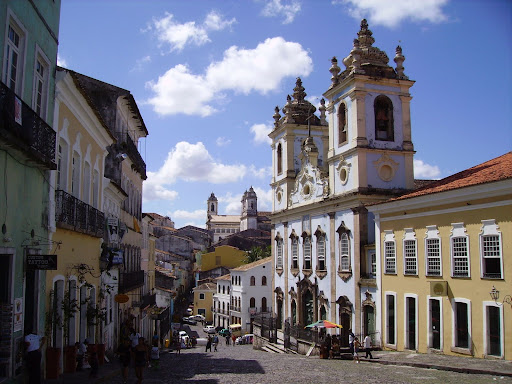
A ten minutes walk from the bus stop to the Terreiro de Jesus, the famous square in the centre of town framed by three of the many beautiful baroque churches that are dotted around Salvador, almost gets me to my destination. The street that takes to Mestre Curio's space starts in the far right corner of the square, just next to the Igreja de Sao Francisco. Relieved by a relatively easy journey, I climb a
set of stairs that seem to be leading to the space, get to an iron gate, ring the bell and wait. It's a warm summer night and outside life carries on as normal. The jazz bar has a different artist on tonight, people stroll around others stop off for a drink, street kids ask for money, the baianas carry on selling their local culinary specialities.
The door opens from upstairs and one of Mestre Curio's students comes down to get me. He must be no more than 17 or 18 but has the assertiveness and confidence of someone who is much older. He isn't of many words and something about him suggests that, despite his young age, he has spent enough time training in the academy to be entrusted with many key tasks.
We walk up the stairs leading onto a nice airy space on the second floor of the building. It is always interesting to get a sense of the spaces in which different masters teach as it often says something about the school. In Mestre Curio's academy the walls and floors are all painted in yellow with drawings of black silhouettes representing elements, symbols and personalities that are important to the school. A giant stylised portrait of Mestre Pastinha - founder of the Angola style in Capoeira and teacher of Mestre Curio- dominates the right hand side wall and sits next to an equally large silhouette of Mestre Curio himself playing the berimbau and wearing his distinctive top hat.
Many schools in Salvador which - like Mestre Curio's- follow from Mestre Pastinha's lineage choose the colours black and yellow as the main ones for their uniforms and general decor of the schools, remaining faithful to the tradition set by Mestre Pastinha himself.
In the middle of the floor a large circle painted in black against the yellow background seems to act as a reminder of the physical boundaries of the roda, the circle where the games of capoeira take place. In the middle of the circle itself two berimbaus - the main musical instrument in capoeira- crossing each other have also been painted along with the words 'Quem nasceu para nos vencer, ja foi vencido' (Those who were born to defeat us have already been defeated), which seems to be as much a reminder of the need to remain humble when entering a game in the roda of capoeira as a whole new perspective on the suffering of the black slave community under European ruling in colonial times.
Mestre Curio's academy and - as I was to discover that night- his rodas seem to have a strong spiritual component, with many elements drawn from Candomble, one of the many manifestations of Afro-Brazilian religious practices developed by the slaves and their descendants in colonial times.
There are many small altars located in various corners of the room, each with a small statue of a deity disguised as a Christian saint. On the far left corner of the room, the largest altar is also the most richly decorated with colourful fabrics, small precious containers and a large image of what looks like Saint George and the dragon. This is also the altar by which Mestre Curio' leaves an offer of a plateful of food before starting the roda.
Much work goes in the preparation of the roda but Mestre Curio is not alone in this process. There are at least ten of his students between the age of 7 and the age of 18 busy ensuring that all duties are covered. It is a very 'young' school and faced with that sight I suddenly remember Mestre Curio mentioning in one of our previous conversations that he works with children as young as 4. Something about the scene that I am faced with suggests that he is pretty successful at retaining them and that, for many of these children, the academy becomes their second home.
Like all other children of their age, they play, they laugh and they chase one another around the room. But once the preparations for the roda begin,the focus and the commitment that they put into ensuring that everything goes ahead smoothly is incredible. Some are preparing an incense burner, others are choosing and arranging the instruments ready for the musicians to use, someone else is checking the register against the people who are present - even Mestre Curio's name gets called!
As Mestre Curio uses the incense burner to cleanse the space where the games of capoeira are about to take place, everyone, from the youngest of the children through to the older students, takes an instrument and starts singing what sounds like the hymn of the school. The ease and the effortlessness with which the kids play the instruments and sing is definitely something worthwhile coming to the other end of the world to witness. Some of them - even those as young as 10 or 11- play the berimbau beautifully, in a way that is clearly second nature to them.
After the hymn has been sung, Mestre Curio uses the incense to cleanse each and every person who is going to take part in the roda, including their feet. It is a powerful ritual and one that - aside from its spiritual meaning- makes me immediately feel part of what is about to happen.
The musicians take their place and the roda begins. Sitting next to the viola, the smallest berimbau, and playing the pandeiro, I have a prime spot to watch how things unfold. The structure of the bateria (the group of instruments played by the musicians) is very similar to the one used in our school and so is the way in which players start and finish their games. Many songs are familiar as well. However, instead of being opened by the most senior students of the school, the roda seems to be started by the youngest ones. Gisele and Besourinho are in first.
The games are very long and everyone gets a chance to warm up and 'find' their movements again very quickly. My first game is with the young lad who came to get me at the door earlier. I feel very welcome as the words of 'Camugere', a song that is often used to introduce and salute a guest in a roda of capoeira, fill the air. The game is slow and tactical and the young man is a very skilful player.
As Mestre Curio told me in one of our later conversations, the style that he endevours to teach is pure Angola, directly following from and attempting to preserve Mestre Pastinha's teaching which are nowadays gradually being lost. He had also added that the Capoeira he teaches is many things - culture,education,self awareness,folklore, tradition- but it's not violence. And these are the principles to which every student is exposed right from the start of their formation within the school.
The playfulness of the young man combined with an acute awareness of the other person's 'open' (and therefore weaker) points of the body do remind me that I am facing a pure Angola player and the game immediately becomes an interesting learning curve. We must have played for no more than ten minutes but all in all that felt like at least half an hour, so many where the new places it was taking me to.
The roda lasts for about two hours, during which many good games take place. Watching them is definitely as absorbing as playing. For the last farewell song, all the musicians stand up and walk anti-clockwise around the two players in the middle, as if to accompany them to the end of the game. Immediately after the game ends,the musicians start playing the rhythm of samba de roda and a twenty minutes dancing session closes the evening on a high note. There is good energy all around and once the samba finishes everyone reaches for a drink of water, realising that they had been going without for about three hours.
Out of breath and drenched in sweat but beaming inside for the great session I get changed and try and catch Mestre Curio before leaving. Handing him my contribution to the session, I express how nice the roda was and congratulate him on his school. He accepts the compliment with a big smile and a quiet nod of the head and gently accompanies me to the door 'Go now, it's getting late for you. See you on Saturday'.
Wednesday, 8 December 2010
Live from Salvador
So I finally arrived in Salvador after a bit of an epic journey which must have lasted a good twenty-four hours in total, involving long queues, missed connection flights and what turned out to be a seven hours´wait at the airport in São Paulo. It´s fair to say the whole experience did feel like a bit of a saga but the gentle pace of life in Salvador, the sun, the heat, the sweetness of the sound of the Portuguese language, the delicious food and the litres of sucos that I am religiously downing every day are working their magic to heal me - completely, mind and body.
Three months in Brazil, a country that I had heard a lot about and that I had learnt about indirectly through Capoeira.After so much anticipation for this, it is hard to believe that I am here.
There are so many things that I expected about Brazil before arriving while, at the same time, I was very aware of the fact that all of these expectations may well be shattered the minute that I arrived. Perhaps the truth lies in the middle, where Brazil it is turning out to be all that I expected it to be and - at the same time- nothing like I thought it was going to be! In a good way, as far as both sides are concerned.
Brazil is immense. Anywhere you are you feel like a tiny little drop in a vast ocean. Arriving in São Paulo the morning of after I took an 11 hours´flight from Heathrow, I was struck by the sheer quantity of domestic flights. It wasn´t just the number of flights but the number of multiple connections of each flight - a plane to Salvador is not just a plane to Salvador; it also stops at Recife, Fortaleza and São Luiz. The distances are so big that it is worth and probably just more efficient to have a network of domestic flights organised in this way.Salvador is a relatively small town, but it still has 3 million people.
The Brazilians are very open, friendly and - above all - always there to help. Perhaps one of the highlights of my first day of classes at the language school was to hear from Professora Kelly that if someone in the street asks ´Tudo bem?´ ( ´All good?`) and you answer `Mais ou menos´ (`more or less`) you will be asked why and how, just because people are generally ready to help. So if your Portuguese vocabulary is not the most exhaustive yet, just say that all is well, or you will get stuck in trying to explain....Noted!
Many capoeiristas are Brazilian, but not all Brazilians practise Capoeira. I had this first perhaps obvious but important realisation when I got on the plane to Sao Paulo and - I confess- in a slight moment of panic thought ´Why am I doing this again? Three months in a country that I have never been to, away from home and all that is known to me, apart from Capoeira?´. Sitting there in a plane full of Brazilians from many walks of life, it suddenly dawned on me that I may have to accept the fact that this trip is also about broadening my horizons into other aspects of the culture to then be able to go back to Capoeira and bring to my experience of it everything else I have seen, felt and understood in other contexts.Yet the first person I had the pleasure of speaking to when I got off the plane in Salvador was Francisco, the taxi driver that took me from the airport to my host family and who - as I learned during a long conversation while stuck in the six o´clock traffic jam in the outskirts of town- had trained with both Mestre Bimba and Mestre Pastinha, the forefathers of Capoeira as we know it today. My expression of surprise made him smile. To me it was a reassuring sign that Capoeira is going to accompany me throughout this trip - as supersticious as this may sound.
Salvador - but perhaps many other places in Brazil that I have yet to see- are an incredible blend of different worlds. In the few days I have spent here I have constantly been tricked by my surroundings. The Barra Shopping Mall in the port area of Salvador may as well be the Friars Shopping Centre in Guildford - same number of shops, variety of goods, brands. In short, same bombardment of choice and prices. Yet walking around the corner from the shopping centre, through the small roads that connect the port to the ´cidade alta´(the high part of town) the most amazing stalls of fresh fruit, coconut, juices and bahian specialities all run by the locals make their appearance.
I have loved being caught by surprise by this and other sights which are everything but European and truly hope this sense of wonder and surprise is going to last throughout this trip.
Three months in Brazil, a country that I had heard a lot about and that I had learnt about indirectly through Capoeira.After so much anticipation for this, it is hard to believe that I am here.
There are so many things that I expected about Brazil before arriving while, at the same time, I was very aware of the fact that all of these expectations may well be shattered the minute that I arrived. Perhaps the truth lies in the middle, where Brazil it is turning out to be all that I expected it to be and - at the same time- nothing like I thought it was going to be! In a good way, as far as both sides are concerned.
Brazil is immense. Anywhere you are you feel like a tiny little drop in a vast ocean. Arriving in São Paulo the morning of after I took an 11 hours´flight from Heathrow, I was struck by the sheer quantity of domestic flights. It wasn´t just the number of flights but the number of multiple connections of each flight - a plane to Salvador is not just a plane to Salvador; it also stops at Recife, Fortaleza and São Luiz. The distances are so big that it is worth and probably just more efficient to have a network of domestic flights organised in this way.Salvador is a relatively small town, but it still has 3 million people.
The Brazilians are very open, friendly and - above all - always there to help. Perhaps one of the highlights of my first day of classes at the language school was to hear from Professora Kelly that if someone in the street asks ´Tudo bem?´ ( ´All good?`) and you answer `Mais ou menos´ (`more or less`) you will be asked why and how, just because people are generally ready to help. So if your Portuguese vocabulary is not the most exhaustive yet, just say that all is well, or you will get stuck in trying to explain....Noted!
Many capoeiristas are Brazilian, but not all Brazilians practise Capoeira. I had this first perhaps obvious but important realisation when I got on the plane to Sao Paulo and - I confess- in a slight moment of panic thought ´Why am I doing this again? Three months in a country that I have never been to, away from home and all that is known to me, apart from Capoeira?´. Sitting there in a plane full of Brazilians from many walks of life, it suddenly dawned on me that I may have to accept the fact that this trip is also about broadening my horizons into other aspects of the culture to then be able to go back to Capoeira and bring to my experience of it everything else I have seen, felt and understood in other contexts.Yet the first person I had the pleasure of speaking to when I got off the plane in Salvador was Francisco, the taxi driver that took me from the airport to my host family and who - as I learned during a long conversation while stuck in the six o´clock traffic jam in the outskirts of town- had trained with both Mestre Bimba and Mestre Pastinha, the forefathers of Capoeira as we know it today. My expression of surprise made him smile. To me it was a reassuring sign that Capoeira is going to accompany me throughout this trip - as supersticious as this may sound.
Salvador - but perhaps many other places in Brazil that I have yet to see- are an incredible blend of different worlds. In the few days I have spent here I have constantly been tricked by my surroundings. The Barra Shopping Mall in the port area of Salvador may as well be the Friars Shopping Centre in Guildford - same number of shops, variety of goods, brands. In short, same bombardment of choice and prices. Yet walking around the corner from the shopping centre, through the small roads that connect the port to the ´cidade alta´(the high part of town) the most amazing stalls of fresh fruit, coconut, juices and bahian specialities all run by the locals make their appearance.
I have loved being caught by surprise by this and other sights which are everything but European and truly hope this sense of wonder and surprise is going to last throughout this trip.
Subscribe to:
Comments (Atom)